

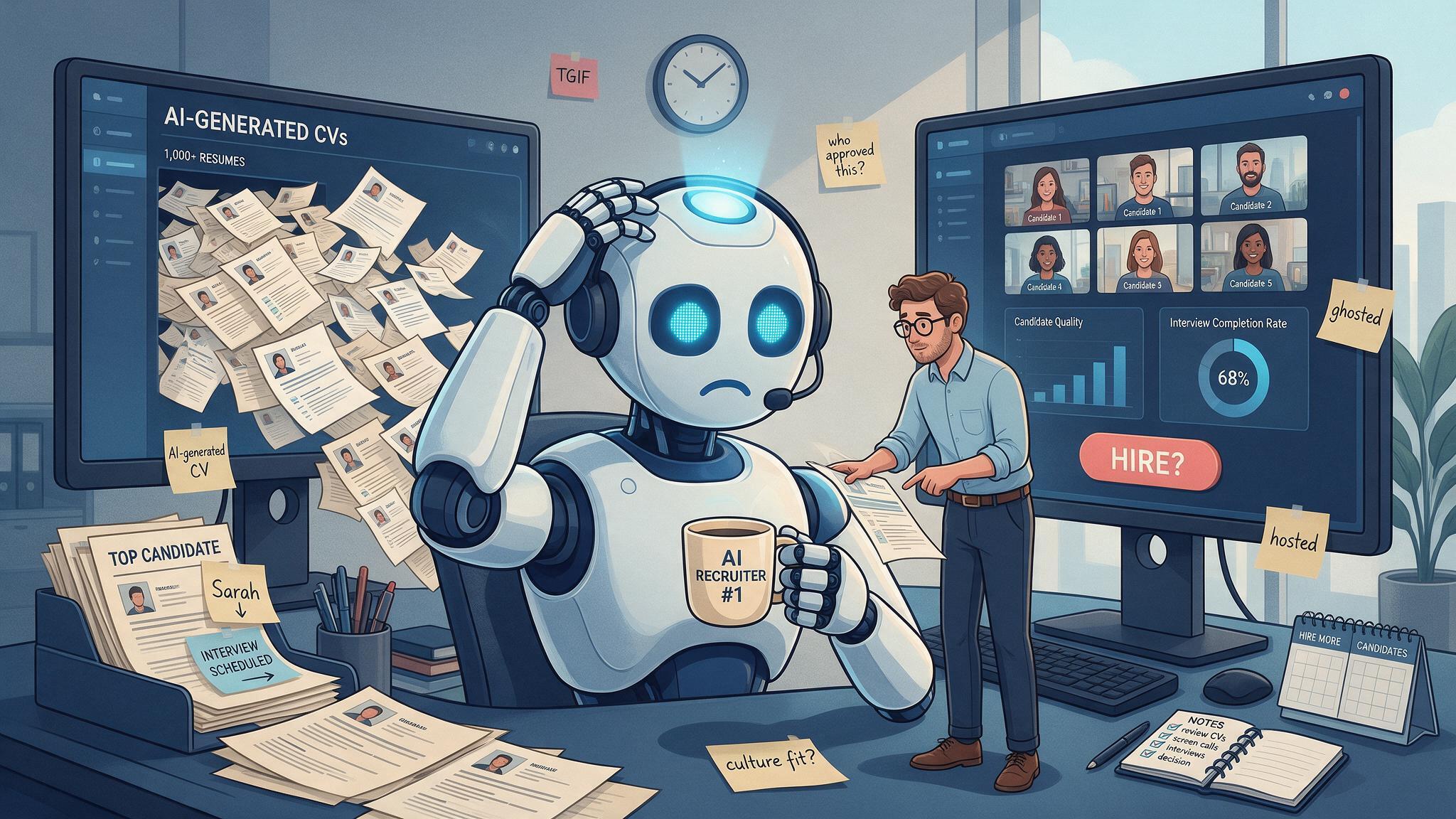
AI has not solved recruitment. It has made the machinery around recruitment faster, louder, and more confident-looking—while leaving the hard part exactly where it was: deciding, with limited information and imperfect people, who should do a job well. In 2026, the recruiter’s value is not disappearing; it is becoming more visible precisely because automation has exposed how much of hiring was never administrative work at all.
The veneer of progress
The modern hiring stack can source candidates, parse applications, draft outreach, summarise interviews, generate scorecards, schedule meetings, and produce dashboards. Metaview, for example, markets agents that review inbound applicants, conduct screening conversations, send outreach, and support interview notes—while explicitly retaining human approval for consequential decisions.
That is genuinely useful. But it is also a veneer: a polished interface over a process whose central questions remain unanswered. What does this role actually require? What evidence distinguishes a strong candidate from a plausible one? Which trade-offs are acceptable? Who is accountable when the hire fails? AI can organise the evidence; it cannot own the judgement.
The application arms race
AI-generated CVs have made the résumé less informative, not more. Candidates can now produce endless tailored versions, optimise for keywords, and present achievements in the language hiring systems are trained to reward. Employers respond with automated screening, skills tests, and stricter filters; candidates respond with more optimisation.
The result is not meritocracy. It is an arms race in which the best-resourced candidates—those with time, coaching, good examples, and prompt fluency—produce the most convincing paperwork. The document increasingly measures presentation rather than capability, while the underlying problem remains: organisations still use a manipulable artefact as the first gate.
An experienced recruiter does not treat the CV as truth. They treat it as a prompt for investigation: What was the person’s actual contribution? What did they own? What happened when the plan failed? Can the claimed impact be tested in conversation? That is not “manual screening”; it is evidence assessment.
Interviews: cleaner notes, same old theatre
AI-augmented video calls promise consistency: transcription, structured notes, competency mapping, and decision-ready summaries. Yet a beautifully summarised bad interview is still a bad interview. If the questions are generic, the panel is unprepared, or the hiring manager is interviewing for familiarity rather than capability, AI simply produces a tidier record of the problem.
The danger is “performative objectivity.” A scorecard makes a decision look rigorous, but if the criteria are vague or the weightings reflect manager preference, the system has not removed bias—it has documented it more efficiently. Structured workflows, clear ownership, explainability, and human review are the actual safeguards; the dashboard alone is not.
Here, the experienced recruiter’s role is to design the encounter before it happens: define job-relevant evidence, calibrate interviewers, challenge vague “culture fit,” and stop a panel from confusing confidence with competence. AI can capture what was said; it cannot reliably decide what mattered.
Agentic recruiting: automation with a human name attached
The 2026 pitch is “agentic recruiting”: AI agents that handle the work between first search and final offer. The language is appealing—recruiters become “talent engineers,” systems become “coworkers,” and hiring becomes “radically efficient.” But efficiency is not the same as effectiveness.
Metaview itself acknowledges the central constraint: its platform should not advance or reject a candidate without a person approving the call, and it says it never auto-rejects applicants. That is sensible governance—but it also reveals the limit of the product. The system can rank, sort, draft, and recommend; the organisation still needs someone competent, informed, and empowered to disagree.
Meaningful oversight requires more than a final click. The reviewer needs to understand the model’s limits, see the underlying evidence rather than merely a score, have enough time not to rubber-stamp, and retain real authority to override without penalty. Without those conditions, “human in the loop” becomes a compliance label rather than a safeguard.
What AI cannot replace
AI is strongest at scale: searching, structuring, scheduling, reminding, summarising, and reducing repetitive administration. It is weakest where hiring is most consequential: ambiguity, context, trust, persuasion, ethical trade-offs, and the messy reality of a person’s career.
| Hiring problem | What AI changes | What remains unsolved |
| Application volume | Faster sorting and keyword matching | Deciding what evidence actually matters |
| CV inflation | Better parsing and comparison | Detecting substance behind polished language |
| Interviews | Notes, summaries, scorecards | Designing a valid, fair assessment |
| Candidate experience | Faster communication and scheduling | Trust, empathy, transparency, and being treated as more than a pipeline record |
| Final decision | A recommendation and audit trail | Accountability for the hire, its risks, and its consequences |
The recruiter’s real job
The experienced recruiter is not valuable because they can read CVs faster than software. They are valuable because they can decide what the organisation is actually trying to hire, translate that into defensible criteria, recognise when the process is producing noise, and take responsibility for a consequential human decision.
That means challenging a hiring manager who wants “someone like the last person,” interrogating an AI-generated shortlist rather than accepting its ranking, noticing when a strong candidate has been filtered out for an irrelevant reason, and maintaining a relationship with candidates who may be rejected today but matter tomorrow. It also means treating AI outputs as evidence to examine—not verdicts to obey.
The honest conclusion
AI has changed recruitment’s user interface: from spreadsheets and inboxes to agents, summaries, and automated workflows. It has not changed its underlying physics: too many applicants, too little signal, misaligned incentives, biased criteria, and decisions made under pressure. In some cases, automation has made those problems worse by increasing volume and giving weak decisions a more authoritative-looking presentation.
The future is not “AI recruiter.” It is an experienced recruiter with better tools, clearer authority, and less administrative drudgery—someone who uses automation to create time for the work that actually determines whether a hire succeeds. The veneer is impressive; beneath it, judgement, context, and accountability remain the product.


